
Getting Out of Debt for the New Year: A 90-Day Plan That Actually Holds
Published August 30, 2026 · By LightPath's IAPDA-certified specialists
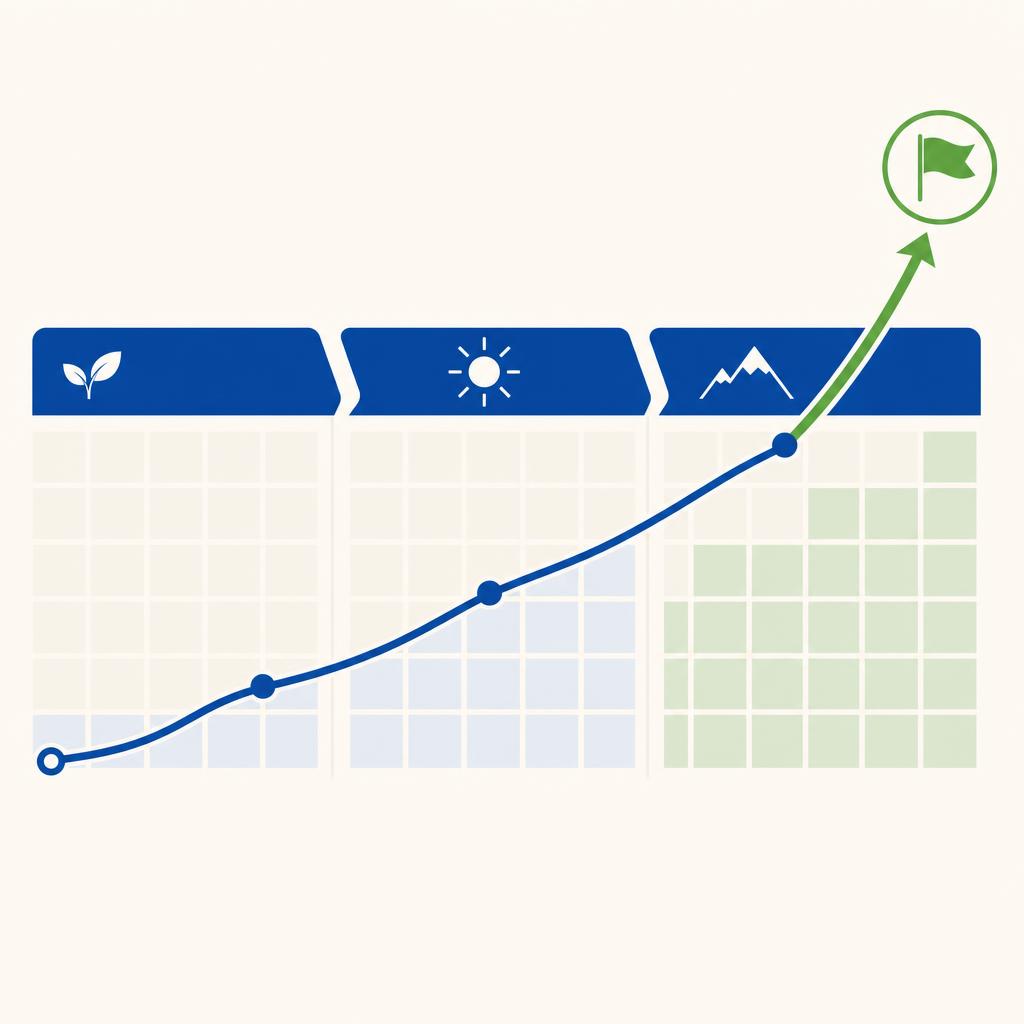
Every January, “get out of debt” lands somewhere near the top of the resolution list. And every February, most of those plans quietly stop. Not because people lack discipline — but because the plan was built on willpower instead of arithmetic, and willpower is a terrible budgeting tool.
So let’s build one on arithmetic. The plan runs 90 days: four weeks to see clearly, four weeks to build the machine, four weeks to prove it works. By the end, it either runs on autopilot — or it makes plain that a different tool is needed, which is just as valuable an answer as the first.
Days 1–30: See the whole thing
You cannot fix a number you haven’t written down. The first month is not about paying anything extra. It’s about ending the fog.
Build the debt inventory
One page. One row per debt. Five columns: creditor, balance, APR, minimum payment, status.
Include everything — cards, store cards, personal loans, medical bills, anything in collections, the buy-now-pay-later balances people forget, money owed to family. Get real balances from statements or online accounts, not memory. Memory is always optimistic.
Then total the balance column and the minimum payment column. That second number is your monthly floor: the amount you must produce just to stay in place.
Find your true monthly margin
Pull the last three months of bank and card statements. Add up everything that left your accounts. Divide by three. That is what you actually spend — not what you think you spend.
Subtract that from your average monthly take-home income. What’s left is your margin. It may be positive. It may be negative. Either answer is useful; only the unknown answer is dangerous.
Run the honest projection
Take your margin, add it to your minimum payments, and estimate how long it would take to clear the balances. A free online debt payoff calculator does this in about two minutes.
If the answer is under five years, this is a payoff problem — solvable with the plan that follows. If it’s seven years or more, or “never” because interest is outrunning your payments, then this isn’t a discipline problem. It’s a math problem, and no amount of skipped coffee will close that gap.
Days 31–60: Build the machine
Now you make it run without you.
Pick a method and stop debating it
There are two credible approaches, and the internet argues about them endlessly. Both work.
Avalanche: pay minimums on everything, throw every extra dollar at the highest-APR debt first. Mathematically optimal. Saves the most interest.
Snowball: pay minimums on everything, throw every extra dollar at the smallest balance first. Costs slightly more in interest, but you close accounts faster, and closed accounts are motivating.
Choose avalanche if you’re motivated by numbers on a spreadsheet. Choose snowball if you’re motivated by progress you can feel. The best method is the one you don’t abandon in March.
Automate the extra payment
This is the single highest-leverage move in the entire plan. Set an automatic transfer for your extra payment amount, dated for the day after payday. Not the end of the month — by then the money is gone.
An automated payment of $150 beats a manual intention of $400, because the automated one happens twelve times a year.
Close the leaks, not the joy
Cancel the subscriptions you forgot about. Call your insurance carrier and re-shop the policy. Ask your cell provider what plan you’d be on if you signed up today. These are one-time phone calls that pay every month afterward.
What doesn’t work: eliminating every discretionary dollar. Keep a small, guilt-free spending line — it’s cheaper than the blowout that follows a month of white-knuckling.
Build the tiny emergency fund first
Put $1,000 aside before aggressive payoff — or one month of expenses if you can. It feels backwards to save while paying interest, but without a buffer, the first car repair goes straight back onto a card and undoes months of work. The buffer is what makes the payoff permanent instead of cyclical.
Call your creditors
Underused and free. Ask about hardship programs, reduced-APR offers, or whether you qualify for a lower rate given your payment history. Not everyone gets a yes. The call costs nothing.
Days 61–90: Prove it and protect it
Do a 30-day audit
At the end of month three, compare projected to actual. Did the automated transfer clear every time? Did the spending average hold? Where did it break?
Most plans break in one predictable place — a category that was budgeted aspirationally rather than honestly. Groceries and eating out are the usual suspects. Adjust the number to reality and rebalance elsewhere. A budget you correct in month three is a budget that survives to month twelve.
Set two checkpoints and stop watching daily
Put two dates on the calendar: a mid-year review and a year-end review. Between them, let the automation work. Checking balances daily doesn’t accelerate anything; it just converts progress into anxiety.
Add to the payoff amount when income changes
Every raise, bonus, or tax refund gets split — part to the payoff, part to life. Sending half of every windfall to debt while genuinely enjoying the other half is sustainable. Sending 100% isn’t, for most people.
When a payoff plan isn’t going to get there
Here’s the part most new-year articles leave out.
A self-directed payoff plan works when income can outrun interest. When it can’t, the failure is quiet: every payment lands on time, and the total at the bottom of the statement barely moves.
The signals are specific:
- You’re making minimum payments and balances are flat or rising
- Your projected payoff is more than five to seven years out
- You’re using one card to make another card’s payment
- Total unsecured debt is approaching or exceeding half your annual income
- You’re covering essentials — groceries, gas, utilities — on credit
This is not a rare situation. The Federal Reserve Bank of New York put U.S. credit card balances at about $1.26 trillion in the second quarter of 2026, with serious-delinquency transitions running near 7% on an annualized basis. Plenty of households doing everything right are still underwater on the math.
If that’s the situation, there are real options, and they’re worth understanding before January turns into another lost year:
- Credit counseling / debt management plan — a nonprofit agency negotiates lower interest rates and you repay the full balance through one monthly payment.
- Consolidation loan or balance transfer — replaces multiple debts with one at a lower rate, if your credit still qualifies you.
- Debt settlement — negotiating with creditors to resolve accounts for less than the full balance. Applies to unsecured debt only. It carries real trade-offs: likely credit damage, possible tax consequences on forgiven balances, and continued collection activity while accounts are unresolved.
- Bankruptcy — a legal process with the strongest protections and the longest credit consequences. For some situations it genuinely is the right answer, and an attorney is the person to ask.
None of these is universally better. They fit different situations, and the honest work is figuring out which one fits yours. We compare all four side by side in Debt Settlement vs. Bankruptcy vs. Consolidation vs. DIY.
The version of this that actually works
Make the resolution smaller and more specific. Not “get out of debt in the new year.” Instead: by March 31, I will have a written debt inventory, an automated extra payment, and a clear answer about whether this plan reaches zero.
That’s achievable in 90 days. And it either gets you moving or gets you honest — both of which beat where most people are in February.
If you reach the end of that 90 days and the math doesn’t close, a conversation costs nothing. LightPath Debt Relief is a debt settlement company with an IAPDA-certified team, and our policy is to say plainly when debt settlement isn’t the right fit. If it is, you approve every settlement before it’s accepted, and no fee is charged until a debt is actually settled and approved. Here’s how the process works, step by step.
Call 1-800-366-4176, Monday–Friday, 9am–6pm ET, or request a free consultation.
Disclaimer: LightPath Debt Relief is a debt settlement company. We are not a law firm, a credit repair organization, a nonprofit credit counseling agency, or a lender, and we do not provide legal, tax, or investment advice. Debt settlement programs are not available in all states. Results vary; no outcome is guaranteed. Please consult a tax professional regarding the tax treatment of forgiven debt.
Common questions
- How do I know if I can pay off my debt on my own?
- Run an honest projection: add your monthly margin to your minimum payments and estimate how long it would take to clear the balances. If the answer is under five years, it’s a payoff problem you can solve yourself. If it’s seven years or more — or never, because interest is outrunning your payments — a payoff plan alone won’t get there.
- Should I build an emergency fund while I’m still paying off debt?
- Yes. Put $1,000 aside first, or one month of expenses if you can reach it. Saving while paying interest looks wrong on a spreadsheet, but without a buffer the first car repair goes straight back onto a card and undoes months of progress.
- Is the avalanche or snowball method better?
- Both work. Avalanche (highest APR first) saves the most interest. Snowball (smallest balance first) closes accounts faster and is easier to stay motivated on. The best method is the one you don’t abandon in March.
- What are the signs a payoff plan isn’t working?
- Balances flat or rising despite on-time payments, a projected payoff beyond five to seven years, using one card to pay another, unsecured debt approaching half your annual income, or covering groceries and utilities on credit. Those are math problems, not discipline problems.